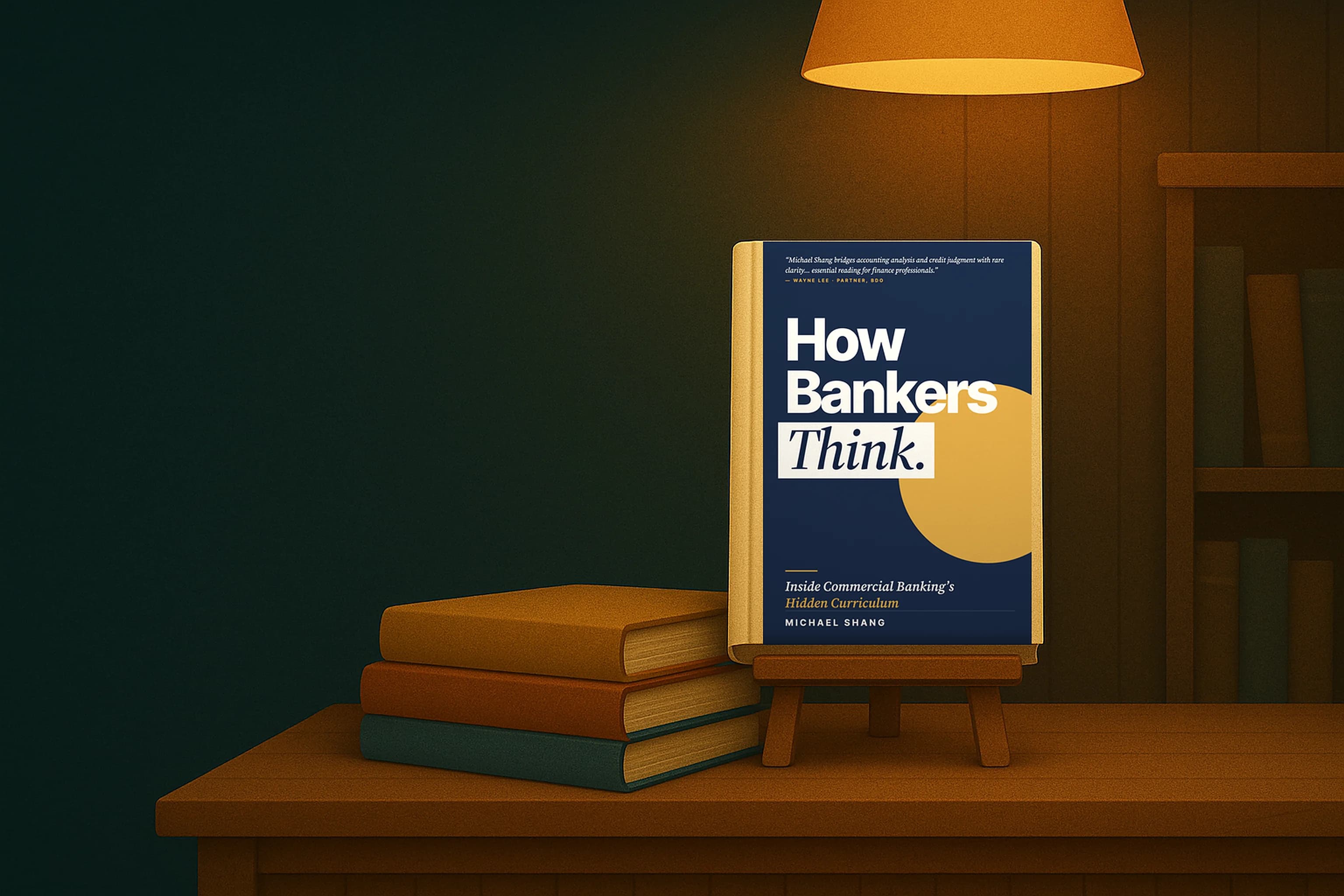
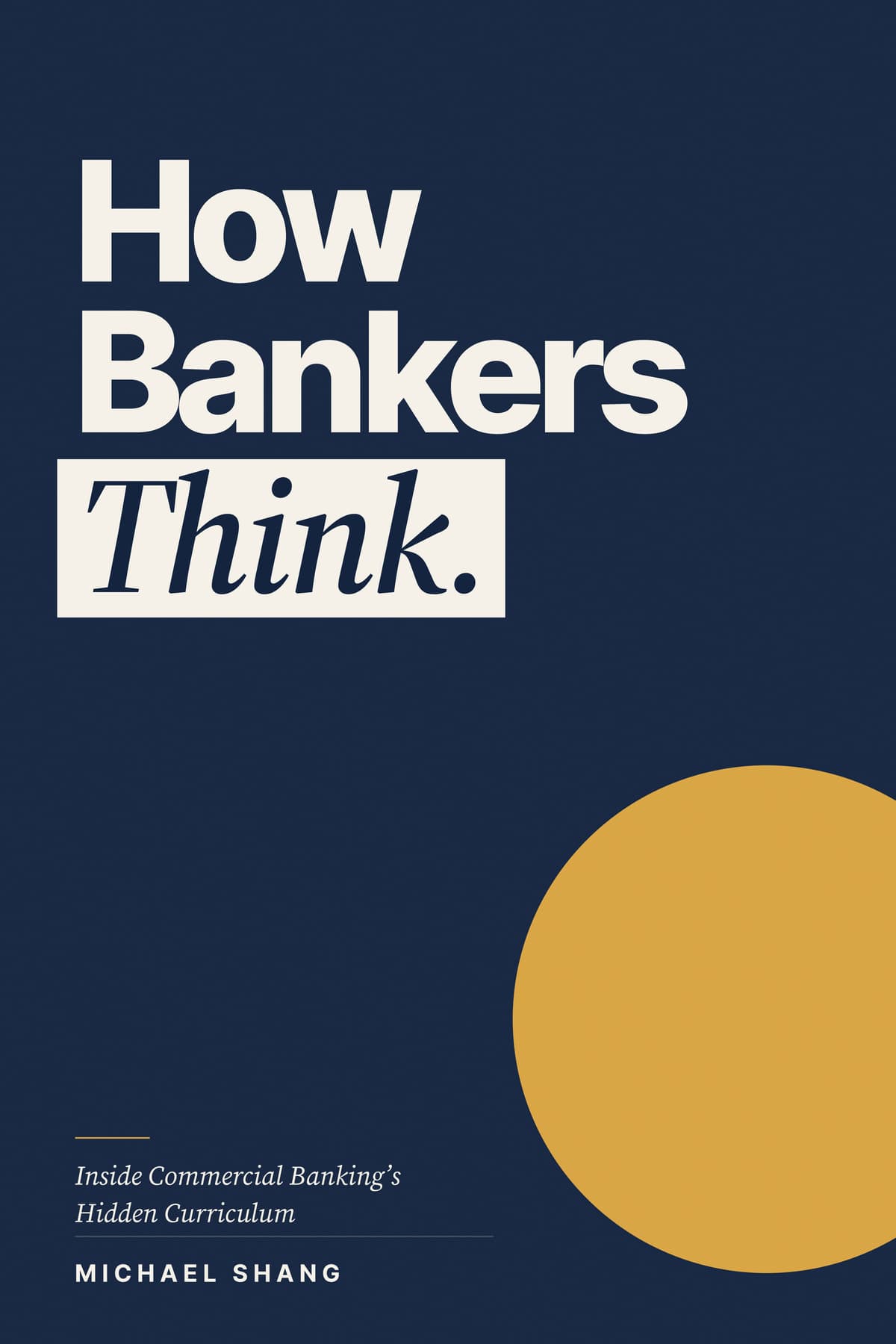
How Bankers Think.
The way commercial bankers actually think — the temperament the interview is really testing, made explicit.
INSIDE COMMERCIAL BANKING'S HIDDEN CURRICULUM
BY MICHAEL SHANG
Independently published · 370 pages
Paperback, ebook, and hardcover available on Amazon.
ABOUT THIS BOOK
There are many guides to breaking into investment banking. There are very few that take commercial banking seriously as its own intellectual discipline — with its own worldview, its own forms of judgment, and its own long arc of professional development.
How Bankers Think is built around a single argument: commercial banking is defined less by its technical content — learnable in a year — than by a specific way of looking at the world, which takes longer to develop and is the actual subject of every interview question, every credit committee, and every client meeting a banker will face.
The book makes that way of thinking explicit. Eight chapters move from the foundational worldview of commercial banking, through the specific instruments of credit judgment, into the deeper disciplines of declining and disagreeing — each chapter built around the frameworks senior bankers actually use and the dispositions they listen for. The eight are named and defined, with their parts, on the frameworks page.
WHAT READERS SAY
“I read How Bankers Think in one go. Michael Shang puts words around instincts that senior bankers carry but rarely articulate clearly. The Three Diagnostics don't feel like academic frameworks — they feel like how someone actually thinks after years on the job.”
“Michael Shang bridges accounting analysis and credit judgment with rare clarity. He shows readers how to look beyond reported profit to the cash conversion, working capital discipline, and facility structure behind every lending decision — essential reading for finance professionals.”
“Most borrowers only understand how their banker thinks once a facility is under stress — by which point the conversation is much harder. Michael Shang explains that thinking before things go wrong. Clear, practical, and grounded in how lending decisions are really made.”
“A thoughtful and well-judged perspective on how bankers evaluate risk and opportunity. Michael Shang provides a clear and practical framework for understanding the considerations that sit behind formal credit processes and commercial lending decisions.”
WHO THIS BOOK IS FOR
- 01
The finance student or career-switcher preparing for commercial banking interviews — who learned the standard frameworks, then discovered the interview was testing how to think, not what to know.
- 02
The early-career junior banker, six to eighteen months in, who is noticing that the decisions they thought were technical are judgment decisions made under incomplete information — and wants the explicit version of what their seniors have internalized.
- 03
The professional from outside banking — lawyer, accountant, corporate executive, policy adviser — who works alongside commercial banks and wants to understand how bankers actually think.
CONTENTS
- Chapter 1 ·Why Bankers Think Differently
- Chapter 2 ·The Hidden Curriculum
- Chapter 3 ·Reading Real Demand vs. Plugging HolesTHE THREE DIAGNOSTICS
- Chapter 4 ·Reading the Numbers Behind the NumbersQUALITY OF EARNINGS TRIANGULATION
- Chapter 5 ·Reading the Industry, Not Just the BorrowerTHE LENDABILITY MATRIX
- Chapter 6 ·Spotting Trouble Before It Spots YouTHE THREE MODES OF WATCHING
- Chapter 7 ·The Deal You Don't DoTHE WALK-AWAY FRAMEWORK
- Chapter 8 ·Reading the Room: The Banker as TranslatorTHE THREE TRANSLATIONS
- Appendix A ·The Banker's Pocket Reference
- Appendix B ·Checklists and Self-Tests
- Appendix C ·Glossary
PUBLICATION DETAILS
Highbank Press · First edition 2026
Independently published · 370 pages
Paperback ISBN 978-1-0672833-0-8
Ebook ISBN 978-1-0672833-1-5
Hardcover ISBN 978-1-0672833-2-2
WHERE TO BUY
Reading this as the person the bankers are reading? The free companion page, How Banks Read You, works three files from the borrower's chair.
All cases in the book are composite illustrations, constructed for teaching. They reflect patterns observed across the author's sixteen years of commercial banking practice but do not represent any actual borrower, transaction, or institution.